

Casper Airport Breaks Ground on New Control Tower, Marking Major Step Forward |
After years of planning, Casper/Natrona County International Airport's long-awaited air traffic control tower project is officially underway. |
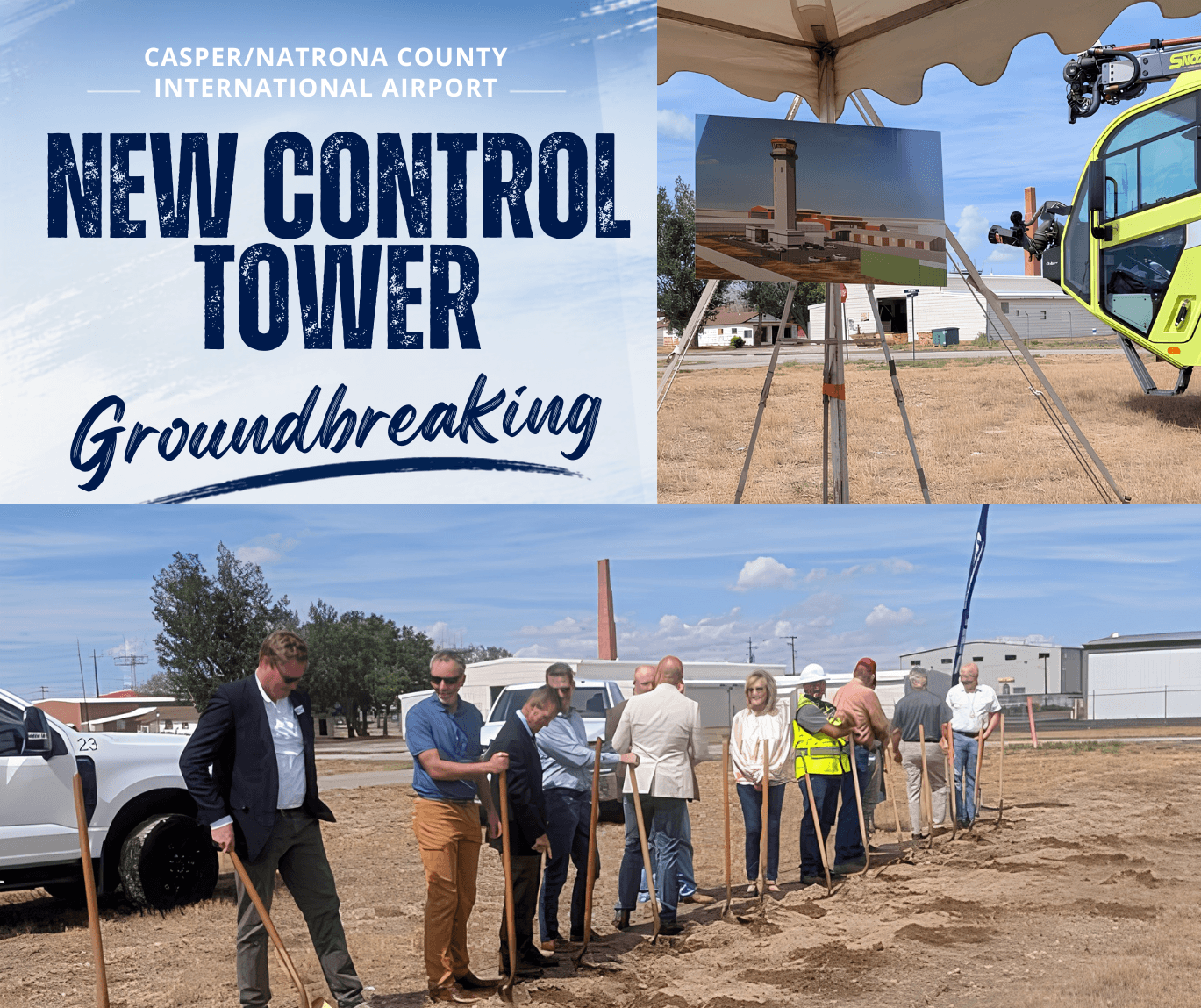
For more than seven decades, a tower overlooking the runways at Casper/Natrona County International Airport has helped air traffic controllers coordinate aircraft moving through central Wyoming.
Now, that chapter is beginning to close.
On Friday, August 14, airport and community leaders gathered for the official groundbreaking of a new air traffic control tower, marking a major milestone for one of Casper's most important transportation facilities. The project will replace the existing tower, which was commissioned in 1954, with a modern facility designed to address longstanding visibility, infrastructure and workspace limitations.
For Casper, the groundbreaking represents more than the beginning of another construction project. It is the result of years of planning, funding efforts and coordination aimed at ensuring the airport has the infrastructure needed to support the diverse aviation activity that takes place across central Wyoming.
A Tower That Has Served Casper for More Than 70 Years
The existing control tower dates back to 1954, when aviation technology and airport operations looked very different from what they do today.
According to USDA Rural Development, the aging tower has significant line-of-sight problems, while its infrastructure and systems have exceeded their useful life. Modernization has therefore become increasingly important for the airport.
But the need for a new tower isn't simply about how many aircraft pass through Casper.
Airport Director Glenn Januska has emphasized the complexity of the airport's operations as an important reason for the upgrade.
Controllers may be coordinating commercial passenger flights alongside large federal air tankers, state helitack firefighting operations, cargo aircraft, customs activity and private flight training. The combination creates a diverse operating environment in which visibility and situational awareness are particularly important.
The new tower is designed to provide controllers with a much better view of that environment.
The planned tower will stand approximately 157 feet tall, significantly higher than the existing structure, improving the viewing angle available to controllers across the airport.
That additional height is intended to address one of the fundamental limitations of the existing facility: the ability of controllers to see aircraft and activity across the airport.
A Modern Facility With More Room to Work
The new tower will also provide something the existing facility increasingly lacks: usable workspace.
The new tower cab will provide approximately 50% more operational space for air traffic controllers, while administrative and management areas will receive more than 150% additional space.
Those improvements may not be as visible to travelers as the tower itself, but they are an important part of the project's purpose.
More functional workspace gives controllers and airport personnel a facility designed around contemporary operations rather than trying to accommodate today's needs inside a structure built more than 70 years ago.
The new facility will also include a Terminal Radar Approach Control, commonly known as TRAC, adding another important component to Casper's modernized air traffic infrastructure.
Rather than simply replacing an old building with a newer one, the project is intended to create a more capable working environment for the people responsible for managing aircraft in the region.
A $30 Million Investment in Casper's Aviation Infrastructure
The new tower represents a $30 million investment in the airport.
Airport Director Glenn Januska provided a detailed breakdown of the project's funding.
The Federal Aviation Administration is contributing $9.5 million, while USDA Rural Development is providing $3 million through its Community Facilities program.
The airport itself is contributing $3 million in airport revenue, and Natrona County is contributing $2 million.
The remaining balance of the $30 million project is being covered by the State of Wyoming through WYDOT and the Governor's Office.
The USDA contribution was formally highlighted during the August 14 groundbreaking. USDA Wyoming State Director Tyler Harrison described reliable and accessible air travel as an important contributor to local economic activity, including business, tourism and jobs.
The funding also demonstrates the broad partnership behind the project.
Federal, state, county and local airport resources are coming together to replace infrastructure that has served Casper since the middle of the 20th century.
Casper's Airport Has Already Reached a Passenger Milestone
The tower project comes as Casper's airport has recently reached an important passenger milestone of its own.
According to the Casper Airport 2025 Annual Report, the airport recorded more than 100,000 passengers in 2025, marking its highest annual passenger count in a decade.
That 2025 record provides additional context for the investment being made in airport infrastructure. The new tower is not being built simply to accommodate a larger number of passengers. As Januska's comments about the airport's diverse operations illustrate, the facility has to support a wide range of aviation activity, from scheduled commercial service to firefighting, cargo, customs, private aviation and flight training.
Passenger numbers are therefore only one part of the airport's overall role in the region.
The tower project addresses the broader aviation environment surrounding those operations.
More Than a Commercial Airport
For many Casper residents, the airport is primarily associated with commercial flights and travel.
But the operations taking place around its runways extend well beyond passenger service.
The airport supports commercial aviation, cargo operations, private aircraft, flight training and emergency-related aviation activity. Its location also makes it an important part of Wyoming's aviation infrastructure during periods of wildfire activity, when firefighting aircraft and other specialized operations can become part of the airport's daily environment.
That diversity is one reason modernizing the control tower matters.
A facility coordinating several different types of aircraft and operations needs infrastructure that allows controllers to maintain strong situational awareness.
The new tower's height, expanded cab and additional operational space are designed around that reality.
A Milestone Years in the Making
The groundbreaking was also the culmination of years of work.
Congresswoman Harriet Hageman said the tower project was among the community projects brought to her attention and that efforts to secure federal funding had been underway for approximately four years.
The August 14 groundbreaking therefore represented an important transition.
For years, the project existed in planning, design and funding discussions. Now, construction has officially begun.
That makes the event more than a ceremonial groundbreaking. It is the point at which a long-discussed modernization project becomes visible and tangible for the community.
Looking Toward the Next Chapter
The new tower will not appear overnight. Construction is expected to take approximately 18 months, meaning Casper residents will be able to watch the project take shape over the coming months.
The existing tower will continue supporting airport operations while the new facility is constructed and prepared for use. Once the new tower is ready, operations will eventually transition to the new facility, with the existing structure ultimately removed as part of the project.
For an airport that has operated with the same control tower since 1954, the transition represents a significant moment.
The old tower is a reminder of Casper's aviation history and the generations of aircraft and travelers it has helped guide through the region.
The new tower represents something different: an investment in the infrastructure needed for the airport's next chapter.
With the August 14 groundbreaking successfully completed, the project has officially moved from years of planning into construction.
And for Casper, that means a major piece of the city's aviation infrastructure is finally getting ready for the future.
At Casper Buzz, we're always looking for the local stories, creative projects, community activities, and people that give Casper its character.
Follow Casper Buzz for more local stories and discover events, businesses, food, music, and experiences around Casper through the Casper Buzz app.
Photo credits: Casper/Natrona County International Airport |
0 Comments
Join the conversation
Be the first to comment
Share your thoughts above.