
Prairie Dog Research Offers New Insight Into Plague Outbreaks Across Wyoming Grasslands |
A free wildlife presentation at the Werner Wildlife Museum will explore how researchers are studying the connections between prairie dog health, colony networks, and the spread of disease. |
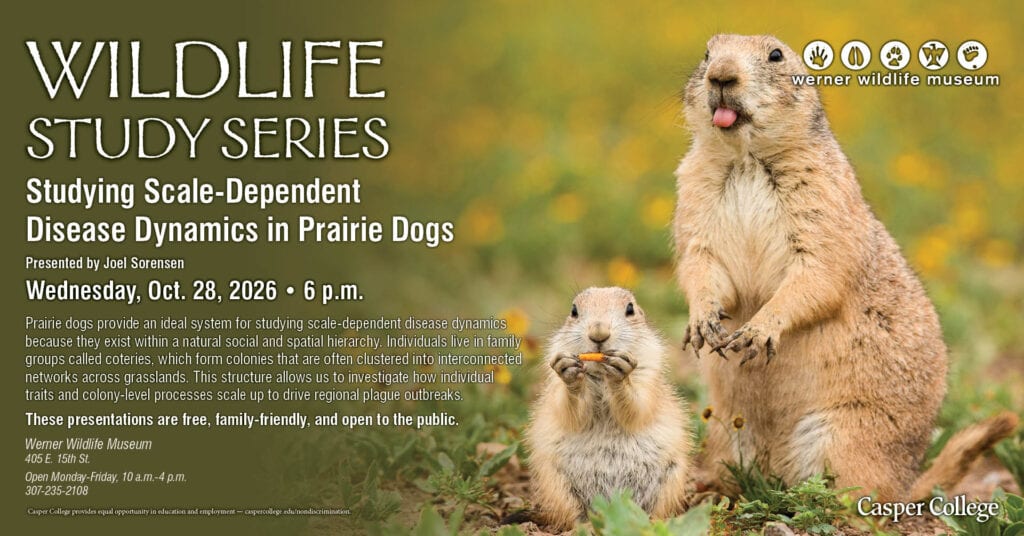
Prairie dogs play an important role in grassland ecosystems, but outbreaks of sylvatic plague can threaten their populations and affect the wildlife that depends on them. In Casper, an upcoming presentation will give residents an opportunity to learn how researchers are investigating the factors that influence these outbreaks and how the findings could help improve wildlife management.
The Werner Wildlife Museum, part of Casper College, will host Joel Sorensen for a presentation titled “Studying Scale-Dependent Disease Dynamics in Prairie Dogs” on Wednesday, October 28. The program begins at 6 p.m. in the museum’s Africa-Arctic Room and is free and open to the public.
Sorensen is a master’s student in zoology and physiology at the University of Wyoming, where he works in the Barrile Lab under Dr. Gabe Barrile. His research examines sylvatic plague in black-tailed prairie dogs at three levels: individual animals, colonies, and entire grassland landscapes. By examining these scales together, researchers can better understand how conditions affecting individual animals and local populations may contribute to broader outbreaks.
Prairie dogs live in family groups known as coteries, which form larger colonies. Across the grasslands of the Western Great Plains, these colonies can form connected networks. Understanding how those networks are arranged and how closely colonies are connected may help researchers investigate how plague occurs and spreads across a landscape.
Sylvatic plague is caused by the bacterium Yersinia pestis and is transmitted by fleas. Its effects can be severe, with outbreaks sometimes causing mortality exceeding 95% in prairie dog populations. Because prairie dogs are a keystone species, their decline can have consequences beyond their own colonies. They provide prey for predators and create habitat used by numerous other grassland species, meaning major population losses can affect the wider ecosystem.
To investigate these relationships, Sorensen is analyzing 20 years of annual prairie dog colony maps from nine grasslands across the Western Great Plains. His work examines colony size, shape, density, and connectivity alongside climate conditions, including precipitation, temperature, and drought indicators. These factors may help reveal patterns associated with where and when outbreaks occur.
The research also looks more closely at connections between colonies and the health of individual prairie dogs. Network analysis helps evaluate whether the spatial relationships among colonies may contribute to disease transmission, while field surveys in Wyoming’s Thunder Basin National Grassland collect information on population density, age, reproduction, body condition, and flea loads. Together, these approaches help link observations from individual animals to larger ecological patterns.
The long-term goal is to provide wildlife managers with better tools for predicting when and where plague outbreaks may occur and for improving the efficiency of mitigation efforts. Although the research focuses on prairie dogs, the questions it addresses reach beyond one species, offering insight into how disease, wildlife populations, and landscape conditions interact.
For Casper residents interested in Wyoming wildlife, ecology, or current university research, the presentation offers a chance to explore the science behind a challenge affecting grassland ecosystems across the region. The Werner Wildlife Museum’s Wildlife Study Series is designed to make wildlife-related topics accessible to the community, and this program welcomes families and members of the public.
The Werner Wildlife Museum is located at 405 E. 15th Street in Casper. Those planning to attend can contact the museum at 307-235-2108 for additional information.
At Casper Buzz, we're always looking for the local stories, creative projects, community activities, and people that give Casper its character.
Follow Casper Buzz for more local stories and discover events, businesses, food, music, and experiences around Casper through the Casper Buzz app. Source/Credit: Casper College, “Learn about disease dynamics in prairie dogs at Oct. 28 Wildlife Study Series.” https://caspercollege.edu/news/2026/10/wildlife-study-series-prairie-dogs/ |
0 Comments
Join the conversation
Be the first to comment
Share your thoughts above.